
AU regulatory guide
Interactive Gambling Act 2001 Explained
The federal statute that governs Australia’s online gambling market. What it prohibits, who it targets, how the 2017 in-play amendment and 2023 credit card ban reshaped it, and what the Murphy Review will bring next.
 Written by
Joshua K.
Last updated:
Written by
Joshua K.
Last updated:
What the Interactive Gambling Act 2001 does
The Interactive Gambling Act 2001, administered by the Australian Communications and Media Authority (ACMA), is the federal statute that governs which forms of online gambling can be lawfully supplied to persons in Australia. It reads as an operator-side regulation. The Act creates offences and civil penalties against any entity providing prohibited interactive gambling services to Australian residents, whether that entity is based in Sydney or in Curaçao.
Two features of the Act shape the entire Australian iGaming landscape. First, its penalties do not reach players. A person who places a bet at an offshore online casino from within Australia is not committing an offence under the IGA. Second, the Act has extraterritorial force. Its penalty regime binds foreign operators just as it binds Australian ones, and ACMA has used this reach to pursue and block over 1,455 illegal offshore sites since November 2019.
The Act at a glance
| Statute name | Interactive Gambling Act 2001 (Commonwealth) |
|---|---|
| Administered by | Australian Communications and Media Authority (ACMA) |
| Regulatory level | Federal. Online casino sits entirely at Commonwealth level, not state. |
| Major amendments | 2017 (in-play sports betting ban) and 2023 (Credit and Other Measures Act). |
| Who it binds | Any operator or financial institution serving Australian players. Not players themselves. |
Federal statute, not state law
Australian gambling law is layered. State regulators like the Victorian Gambling and Casino Control Commission and Liquor and Gaming New South Wales handle in-venue gambling and licensed wagering within their state. Online casino, online poker and interactive gambling sit entirely at the federal level under the IGA. That means no state licenses an online casino for Australian players, no state can carve out an exemption, and every enforcement action against an offshore operator flows through ACMA under Commonwealth authority.
The full list of prohibited interactive gambling services
Section 15 of the Act makes it an offence to provide a prohibited interactive gambling service to a person physically present in Australia. The definition of prohibited is broad and covers virtually the entire online casino product suite plus in-play sports betting.
The six prohibited service categories
Each of the following is a prohibited interactive gambling service under the Act when supplied online to persons in Australia.
-
Online casino games
Pokies, blackjack, roulette, baccarat, craps, video poker, live dealer games. This category is the largest prohibited product class.
-
Online poker
Cash games and tournaments, regardless of the poker variant. All PokerStars, GGPoker and equivalent operators were formally blocked in 2017.
-
In-play sports betting online
Bets placed after a sporting event has started are prohibited if placed through an online channel. Phone-based in-play remains permitted through licensed wagering operators.
-
Online keno
Added as a prohibited category in the government’s May 2026 Murphy Review response. Legislation to formalise the ban is due before the 2027 commencement date.
-
Bets on the outcome of games of chance
Products that treat chance outcomes as bettable events fall inside the prohibition, distinct from fixed-odds betting on sport or racing.
-
Betting exchanges offering prohibited products
Peer-to-peer exchange platforms fall inside the prohibition when they facilitate any of the above product categories to Australian residents.
Section 15 sets the operator penalty regime
Section 15 of the Act is the operative provision. It makes it a civil-penalty offence to provide a prohibited interactive gambling service to a person physically present in Australia. The penalty scale is deliberately steep, and the offence is a continuing one, which means each day of provision counts as a separate breach for the purposes of maximum-penalty calculation.
Section 15 penalty structure
| Maximum civil penalty per breach | A$234,750 for an individual. Corporate penalties multiply this on a per-officer basis. |
|---|---|
| Continuing offence | Yes. Each day the prohibited service is provided constitutes a separate breach. |
| Extraterritorial reach | Yes. Foreign operators serving Australians can be pursued in the Federal Court of Australia. |
| Player-side liability | None. Players placing bets at prohibited services commit no Australian offence. |
Federal Court has heard IGA cases involving foreign operators
The extraterritorial reach is not theoretical. The Federal Court of Australia has heard several IGA enforcement matters involving offshore operators, and civil penalties have been ordered against corporate defendants that never held any Australian presence. The Court’s willingness to accept jurisdiction over foreign operators marketing to Australian residents is the key reason ACMA’s blocklist mechanism functions as a credible deterrent rather than a symbolic gesture.
The 2017 amendment banned in-play sports betting
Before 2017, Australian bettors could place in-play sports bets through online channels using a legal loophole. Operators had exploited the click-to-call workaround, in which a customer clicked a button on an app that placed a phone call to a licensed operator’s automated system, which technically satisfied the phone-only requirement while functioning like a click-through online bet. The Interactive Gambling Amendment Act 2017 closed that loophole and reasserted the in-play ban’s original intent.
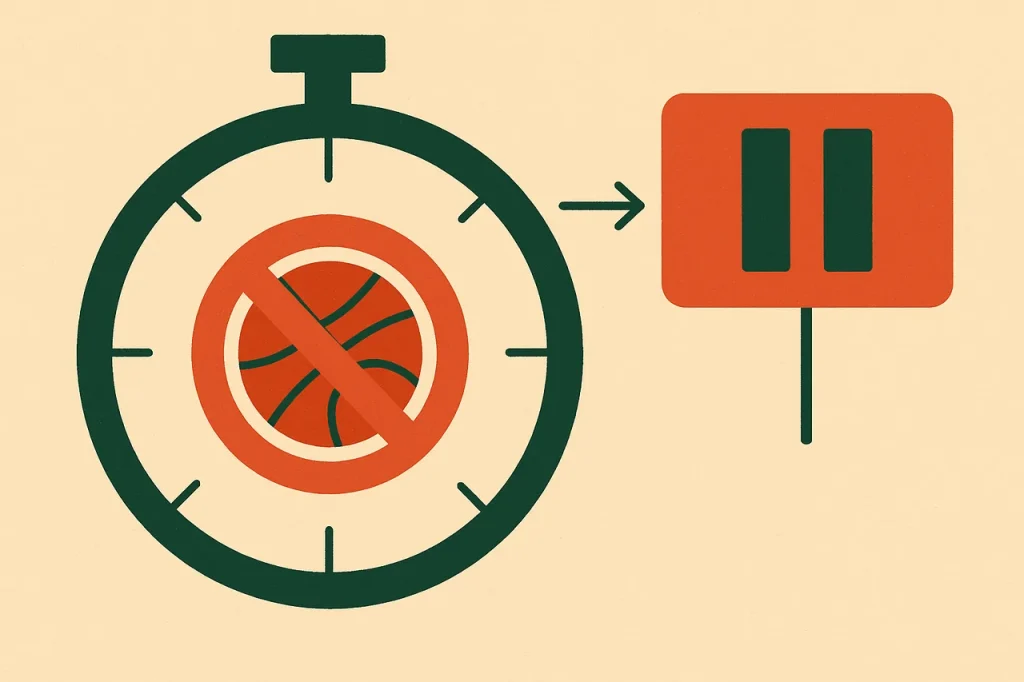
What in-play means and why it is regulated
In-play betting is a bet placed after a sporting event has started. Because the odds move continuously during the match, in-play carries a higher velocity and risk profile than pre-match fixed-odds betting. Australian public policy treats in-play as sitting closer to casino-style gambling than to considered sports wagering, and the 2017 amendment reflects that classification. In-play remains permissible when supplied through a licensed phone-based channel to preserve access for punters who prefer live betting, but the online in-play product is fully off-limits.
How ACMA enforces the online in-play ban today
Licensed Australian wagering operators (Sportsbet, Ladbrokes, TAB and equivalents) are audited on their in-play offerings and cannot expose an online in-play product to Australian residents without breaching their state licence conditions. Offshore sports books targeting Australians face the same section 15 exposure as offshore casinos. ACMA’s blocklist has included several offshore sportsbook brands where the primary offence was providing online in-play markets to Australian residents.
The 2023 Credit and Other Measures Act closed the credit rail
The Interactive Gambling Amendment (Credit and Other Measures) Act 2023 received Royal Assent on 11 December 2023 and its main operative provisions commenced on 12 June 2024. It was the first substantive change to the IGA payments framework in over two decades and it hit offshore casinos as squarely as licensed Australian wagering.
What the 2023 amendment changed
| Effective date | 12 June 2024 for main provisions. A six-month soft-launch preceded strict enforcement. |
|---|---|
| Instruments banned | Credit cards, credit-linked digital wallets, and cryptocurrency purchased on credit for the purpose of gambling. |
| Extends to offshore | Yes. Offshore operators accepting Australian credit-instrument deposits face the same civil penalties as domestic wagering. |
| Who bears liability | The operator and the financial institution processing the transaction. Not the player attempting the deposit. |
The offshore reach was deliberate
Parliament made the extraterritorial reach of the credit ban explicit in the drafting process. The bill’s explanatory memorandum records that a domestic-only ban would have simply pushed Australian gamblers toward offshore operators willing to process credit-card deposits, undermining the harm-reduction rationale entirely. Extending the ban to any operator serving Australians closed that arbitrage path. Australian banks are simultaneously required to flag and block credit-card transactions routed to gambling merchant codes, adding a second layer of enforcement at the payment-rail level.
How ACMA enforces the Act in practice
ACMA’s enforcement toolkit runs three levers in combination. Civil-penalty proceedings in the Federal Court against operators that continue to serve Australians after formal warning. Section 313 disruption requests to Australian internet service providers, blocking access to identified illegal sites at the ISP level. And investigation referrals to overseas regulators where the offshore operator holds a licence that its own regulator can act upon.
The enforcement workflow
Every enforcement action moves through a defined sequence. The details on the Is Online Gambling Legal in Australia guide cover the blocking pipeline in depth. The four-step summary here focuses on how the Act itself gets applied.
-
Complaint intake and finding
ACMA accepts complaints via its illegal-online-gambling form, verifies the operator is targeting Australians and issues a formal finding of a section 15 breach.
-
Formal notification of the operator
ACMA writes to the operator setting out the alleged breach and requiring cessation. Continued operation after this notice is what triggers the continuing-offence penalty calculation.
-
Section 313 ISP disablement request
ACMA passes the finding to Australian ISPs asking them to disable access to the identified domain. Tier-1 providers comply in practice within days.
-
Federal Court proceedings where warranted
For repeat or high-volume offenders, ACMA commences civil-penalty proceedings in the Federal Court. Judgment can be enforced against overseas operators through reciprocal enforcement arrangements.
The blocklist is public
ACMA publishes each round of new blocks in a monthly bulletin at acma.gov.au. The running list is a useful due-diligence resource for Australian players: any casino brand appearing on the list is not one where a payout dispute is realistically recoverable. New mirror domains often reappear inside a fortnight and cycle back into the same pipeline, so a fresh check before each significant deposit is worth the two minutes it takes.
What the Act does not cover
The Act’s federal scope leaves several adjacent gambling categories untouched. Understanding what sits outside the IGA is as important as understanding what sits inside, especially for readers navigating the intersection with state-level licensing.
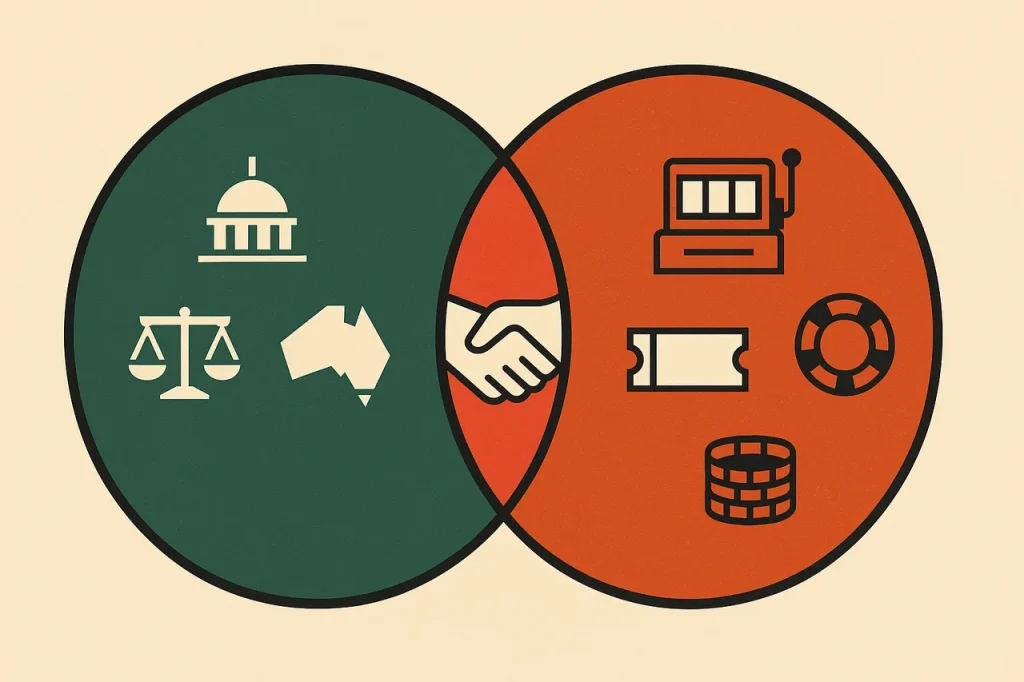
Inside and outside the Act's reach
- Online casino games in all their variants
- Online poker cash games and tournaments
- Online in-play sports betting
- Credit-instrument gambling deposits after June 2024
- Licensed state-regulated wagering (sports and racing) supplied online
- Licensed state or territory lotteries and scratch products
- In-venue gambling (pokies, land-based casinos, wagering shops)
- Player-side conduct. Placing a bet at a prohibited service is not an IGA offence.
State-level gambling sits under different statutes
Pokies in Victorian pubs and clubs sit under the Victorian Gambling and Casino Control Commission’s remit under the Gambling Regulation Act 2003 (Vic). New South Wales pokies fall under Liquor and Gaming NSW. Queensland runs under the Office of Liquor and Gaming Regulation. Each state has its own licensing regime, harm-minimisation rules and self-exclusion programs. The IGA covers only the online-interactive-gambling boundary, and it never authorises a state to license online casino for Australian players.
The Murphy Review response and the 2027 outlook
In May 2026, the Albanese government released its response to the 2023 Murphy Review of online gambling harm. The response package committed A$112.7 million to gambling-harm measures and set several IGA-adjacent changes for commencement from 1 January 2027, subject to legislation passing through both houses.
Changes flagged for 2027 commencement
| Gambling advertising ban during live sport | Between 6am and 8:30pm plus five minutes either side of any live-sport broadcast on television or radio. |
|---|---|
| End of stadium and uniform sponsorship | At contract expiry. Sportsbet, Ladbrokes and equivalents will progressively withdraw from stadium naming and team-uniform placements. |
| Ban on online keno | Adds keno to the section 15 prohibited-services list. Currently a grey area; will be explicit under the amended Act. |
| Stronger illegal-gambling enforcement funding | Additional resources for ACMA blocklist processing plus more capacity for cross-border enforcement referrals. |
No signalled legalisation of online casino
The Murphy Review response deliberately stopped short of legalising or licensing online casino for Australian players. Multiple submissions to the review urged the government to open a domestic-licensed online casino regime as a harm-reduction measure, on the theory that a licensed local product with player-protection controls would be safer than an offshore one without them. The government rejected that path. The IGA’s operator prohibition on online casino is not scheduled for repeal, and the direction of travel through to at least 2028 is tighter enforcement rather than legalisation.
Frequently asked questions
It is Australia’s federal law governing which online gambling products can lawfully be supplied to Australian residents. It prohibits online casino, online poker and online in-play sports betting when offered to persons in Australia, and it targets the operators offering those products rather than the players placing bets.
Yes, and it has been amended twice since original commencement. The 2017 amendment banned online in-play sports betting. The 2023 Credit and Other Measures Act banned credit cards, credit-linked wallets and credit-purchased cryptocurrency for gambling deposits, effective 12 June 2024. Further changes are scheduled for 1 January 2027 subject to legislation passing.
Yes. The Act has extraterritorial reach. Any operator that supplies a prohibited interactive gambling service to a person physically in Australia commits an offence under section 15, regardless of where the operator is based. ACMA has pursued Federal Court proceedings and ISP-level blocks against many offshore operators.
No. The Act targets operators, not players. No Australian resident has ever been prosecuted under the IGA for the mere act of gambling at an offshore online casino. The compliance burden and the enforcement risk sit entirely with the operator.
Before 2017, licensed Australian wagering operators had exploited a click-to-call workaround to offer online in-play sports betting through what was technically a phone-based system. The 2017 amendment closed that loophole so that in-play sports betting remained available only through genuine phone-based channels, restoring the original policy intent of the Act.
Subject to legislation passing, the May 2026 government response to the Murphy Review flagged a gambling advertising ban during live-sport broadcasts, the end of stadium and uniform sponsorship at contract expiry, an explicit ban on online keno, and additional funding for ACMA’s illegal-gambling enforcement work. No legalisation of online casino is signalled.
Sources
- ACMA overview of the Interactive Gambling Act 2001
- Parliament of Australia bill digest, Credit and Other Measures Act 2023
- Department of Infrastructure media, interactive gambling regulation
- ACMA latest illegal offshore gambling website blocks
- The Conversation, Australian gambling reform response May 2026