
Pokies playbook
Pokies RTP Explained
The number that decides which pokie is worth your bankroll. What RTP really means, how volatility multiplies it, why provider studios differ, and how to check the RTP of any game in thirty seconds before you deposit.
 Written by
Joshua K.
Last updated:
Written by
Joshua K.
Last updated:
What RTP actually means
Return to Player is the percentage of total money wagered that a pokie is programmed to pay back over its lifetime. A game with a 96 per cent RTP will, across millions of spins, return 96 cents of every dollar staked and keep 4 cents as the house edge. The number is a mathematical certainty programmed into the game engine, verified by an independent test lab before certification, and locked at the RTP the studio published. It is not marketing.
The number that matters day to day is the flip side. The house edge is one hundred minus the RTP, so a 96 per cent game carries a 4 per cent house edge, a 97 per cent game carries 3 per cent, and a 98 per cent game carries 2. Halving the house edge doubles how long the same bankroll lasts on average, which is why chasing higher-RTP games is the single most useful habit for extending session length.
The house edge in one glance
| RTP 92% | 8 per cent house edge. Avoid unless the game has a compensating feature you value. |
|---|---|
| RTP 94% | 6 per cent house edge. Common floor for licensed operators. Passable but not preferred. |
| RTP 96% | 4 per cent house edge. Industry midpoint. The default for most quality studios. |
| RTP 97-98% | 2-3 per cent house edge. Best band for extended play. Actively seek these out. |
| RTP 99%+ | Rare. Usually a promotional or high-limit version. Verify before you deposit. |
The gap between long-run RTP and your session
RTP is a long-run figure. It emerges over millions of spins across every player who has ever touched a title. Any individual session you sit for will not track the published RTP. It will run high or low around it, sometimes dramatically, and that variance is what actually decides how the session feels. The mathematical truth of a 96 per cent RTP is not that you get back 96 cents on every dollar this hour. It is that after enough hours across enough players, the aggregate settles there.
How volatility decides the shape of your session
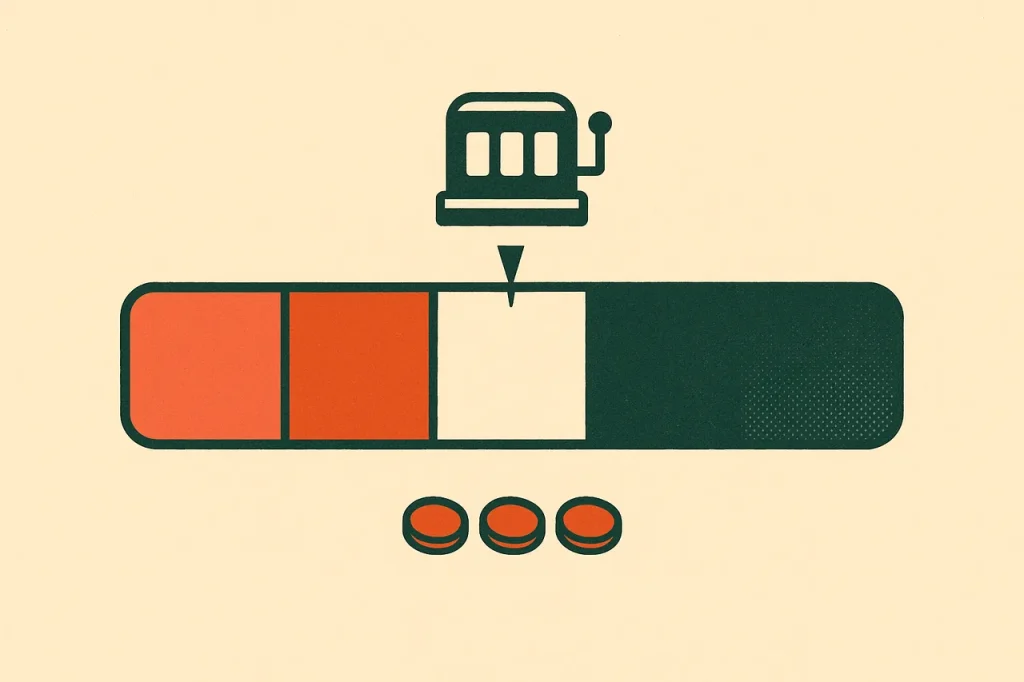
Volatility is the second lever after RTP, and just as important. It describes how the payouts of a pokie are distributed. Low-volatility games hit small wins often, keeping the credit balance moving and the session feeling active but rarely producing big swings. High-volatility games are the opposite: long dry stretches punctuated by rare high-payout hits. Medium volatility sits in the middle, which is where most flagship titles are tuned.
Volatility tiers at a glance
| Low volatility | Small frequent wins. Session lasts long on a modest bankroll. Rare big hits. Suits players who want extended play time. |
|---|---|
| Medium volatility | Balanced hit frequency and payout size. Most mainstream titles land here. A safe default when picking blind. |
| High volatility | Long dry stretches then large hits, sometimes 500 to 5000 times bet. Needs a bigger bankroll to survive dry runs. |
Provider studios differ, sometimes a lot
Every major provider studio publishes its own RTP standards, and they are not identical. Some studios habitually ship games in the 96 to 97 per cent band, some sit lower, and some offer configurable RTP versions where operators can select the tier they license. Knowing which studios habitually publish higher-band RTPs saves time when browsing a game library.

Six major studios compared
Typical RTP bands and the reputation each studio has built for hit frequency and top-win potential.
| Feature | Studio | Typical RTP | Reputation |
|---|---|---|---|
| NetEnt | 96.0 – 97.0% | Yes Reliable mid-band, polished maths | |
| Play’n GO | 94.0 – 96.5% | Configurable RTP; verify per operator | |
| Pragmatic Play | 94.0 – 96.5% | Configurable RTP; huge library breadth | |
| Nolimit City | Yes 96.0 – 96.5% | Yes Consistently high band, extreme volatility maths | |
| Hacksaw Gaming | Yes 96.0 – 96.5% | Yes Very high-vol titles with high top-win caps | |
| Betsoft | 94.0 – 96.0% | Wide range; check individual title |
Bands reflect industry-wide operator releases. Individual titles vary within each studio’s range.
The configurable-RTP catch
Studios like Play’n GO and Pragmatic Play produce many of their headline titles in multiple RTP versions and let each operator choose the tier when they license the game. Which means the same title at Casino A might ship at 94 per cent while Casino B ships it at 96.5 per cent. Always check the RTP in the game info panel of the specific casino you are playing at, because the studio badge alone does not tell you the tier that operator picked.
How to check the RTP of any pokie in thirty seconds
Every legitimate pokie exposes its RTP inside the game itself. The information is behind a small info button, usually a lower-case i or a question mark, sitting somewhere on the game screen. The check takes half a minute and it is the single most valuable habit before you commit a deposit to a title.

The thirty-second RTP check
Do this once per new title. Two runs and it becomes reflex.
-
Open the game in demo mode first
Almost every offshore casino allows demo play. Use it to reach the RTP panel without committing a real-money deposit.
-
Find the info button
Look for a lower-case i, a question mark or a small menu icon. It is usually in a corner of the game screen. Tap or click to open the paytable.
-
Scroll to the game info page
The RTP figure lives on the last page of the paytable in most modern pokies. It is often labelled RTP, Return to Player or theoretical return.
-
Note the tier
If it is 96 per cent or above, the game is at industry standard or better. Below 94 per cent, look for a different title in the same studio.
-
Cross-check against the provider’s baseline
If the RTP in the game info panel is lower than the maximum RTP the studio publishes for that title, the operator has licensed a lower-tier version. Choose a casino running the higher-tier release.
Three myths that cost players money
Pokies attract a lot of misconception. Some of the beliefs are folk wisdom passed down from land-based venues. Others are hopeful patterns players read into random noise. All three below are worth unlearning because they lead to bigger bets in worse spots.
Myth one – a machine is due to hit after a dry streak
Every spin is independent. The pokie has no memory of the last spin or the last thousand. A cold streak carries no obligation to a hot one, and the game engine has no dial that gets primed after a run of losses. Betting up during a dry streak because the machine is due gives back more of your bankroll to the house edge in bigger increments.
Myth two – bigger bets improve the odds
Bigger bets change the payout on wins but not the probability of a win. Every spin at a given pokie carries the same win probability regardless of stake. Betting higher does not unlock features that were withheld at the lower stake unless the game explicitly gates a bonus buy or feature at a specific bet size, and those are always documented in the paytable.
Myth three – auto-spin gives worse outcomes than manual
The RNG does not care whether you tapped spin or the machine did it for you. Auto-spin is a UX feature, nothing more. Outcomes are identical. The only real risk with auto-spin is that it removes the pause between spins during which a human decides whether to keep going, so a bankroll can drain faster in wall-clock time. That is a behavioural risk, not a mathematical one.
Bankroll strategy that survives variance
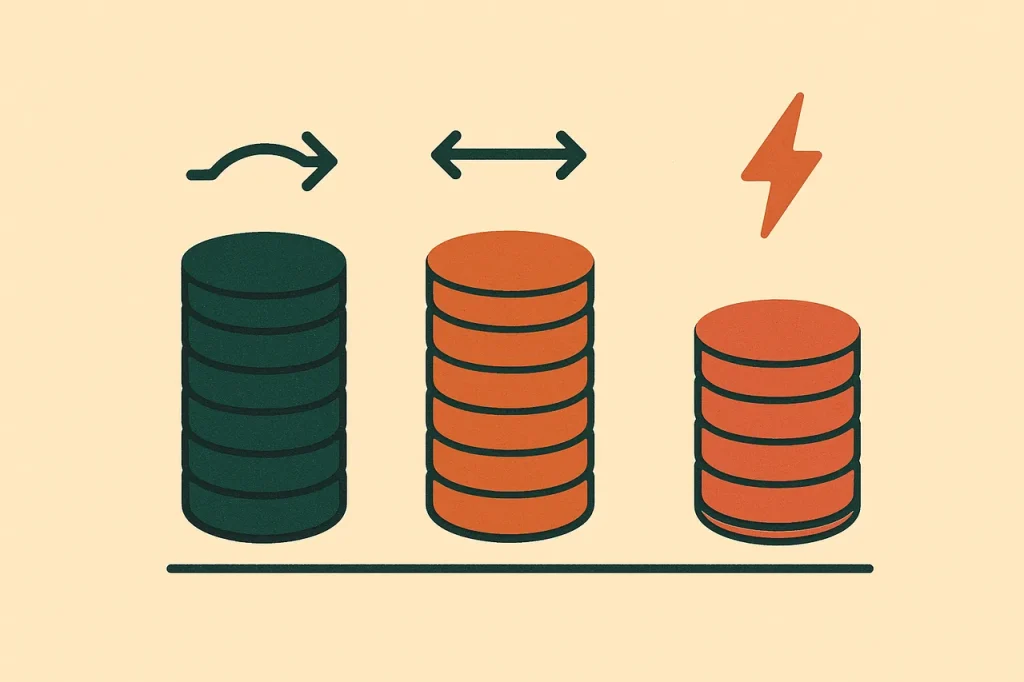
The single most useful bankroll rule is to size your bet against the number of spins your session bankroll would fund at the pokie you are playing. Lower volatility survives shorter session budgets. High volatility needs enough spins in the tank to weather a long dry stretch before the game pays. The ratios below are rough, but they get players close enough to survival on the first pass.
Sizing a session bankroll by volatility
Assume a comfortable session is 200 to 400 spins. Divide bankroll by the target spin count to get bet size.
-
Low volatility, target 200 spins
Small frequent wins keep the balance moving. A A$100 bankroll survives comfortably on A$0.50 bets across 200 spins with reasonable variance protection.
-
Medium volatility, target 300 spins
Balanced hit frequency. A A$100 bankroll suits A$0.30 to A$0.35 bets across 300 spins. Modest cushion for the occasional cold stretch.
-
High volatility, target 400+ spins
Long cold stretches are the norm. A A$100 bankroll needs A$0.20 or lower bet size to survive long enough for the rare high hit to land. Betting bigger without a bigger bankroll is how high-vol pokies end sessions early.
Where to apply this on a real casino
The right places to run RTP-first game selection are casinos with big enough libraries to compare RTP versions across studios. The online pokies shortlist covers casinos with the widest high-RTP catalogues, and each of the recommended operators publishes the RTP in every game’s info panel so the thirty-second check works out of the box.
The RTP versus max-win tradeoff
RTP is not the only lever a studio dials in when tuning a pokie. Alongside it sits the maximum win multiple, usually expressed as a cap on how many times the bet size a single spin can pay. A game with a 5,000x max-win pays five hundred thousand dollars on a A$100 spin at its ceiling. Games with lower max-win caps typically ship at higher RTPs, and games with sky-high caps often ship lower. The two dials trade off against each other in the studio maths.
Which lever matters more depends on the session goal. Chasing a life-changing top win means accepting a lower RTP for a higher ceiling. Wanting bankroll longevity and steady wins means accepting a lower top-win cap for the extra one to two per cent of RTP that comes with it. Neither choice is wrong. The mistake is treating them as if they were unrelated, choosing a game because it advertises a huge max-win, and not noticing the RTP dropped to 94.5 per cent to make that cap possible.
How the two dials trade off, typical patterns
| Ceiling 500x – 1,000x max-win | Typically RTP 96.5 – 97.5 per cent. Comfort-first pokies for steady play. Session-friendly. |
|---|---|
| Ceiling 5,000x max-win | Typically RTP 96.0 per cent. Industry midpoint. Balanced for both goals. |
| Ceiling 10,000x max-win | Typically RTP 95.0 – 96.0 per cent. Chase-friendly but longer cold stretches. |
| Ceiling 20,000x – 50,000x max-win | Typically RTP 94.5 – 95.5 per cent. Rare monster wins, but longest bankroll grind to reach them. |
Bonus buy features and how they change RTP
Bonus buy is a mechanic Nolimit City popularised and most modern studios now offer on their headline titles. For a multiple of bet size (usually 80x to 200x) the player skips the base game and jumps straight into the free-spin round. The published RTP on bonus-buy purchases is usually slightly higher than the base-game RTP because the operator no longer needs the base-game grind to fund the eventual free-spin payout. That extra half-per cent or one per cent of RTP is the reward the studio pays for turning a slow-burn player into a big-single-cost bettor.
The catch is variance. Buying the bonus places one large bet in the exact spot in the game maths where the biggest variance lives. A 100x bonus buy costs 100 times the base bet in a single decision. Winning is possible, common on Nolimit City titles, but losing is also common and often fast. Bonus buy is not a shortcut to profit. It is a compressed high-variance version of the same maths.
When bonus buy is worth using
- Bankroll large enough that a full miss is absorbable (10x the buy cost minimum)
- You have already played the base game long enough to know its rhythm
- The published bonus-buy RTP is 97 per cent or higher (Nolimit and Hacksaw titles often qualify)
- Small bankroll where two consecutive misses would end the session
- Bonus-buy RTP is not disclosed separately from the base RTP
- You have an active bonus balance (bonus buys are usually forbidden during bonus play)
How live dealer RTP compares to pokies
Live dealer tables carry their own RTP structure, and it is often noticeably better than pokies. European roulette runs a 2.7 per cent house edge (97.3 per cent RTP) against a single zero pocket. Blackjack under standard rules with basic strategy sits at roughly 0.5 per cent house edge (99.5 per cent RTP). Baccarat banker bet runs 1.06 per cent house edge (98.94 per cent RTP). Compared to the 96 per cent industry midpoint on pokies, live dealer is structurally better value per dollar wagered.
The catch is game weighting during bonus play. Almost every operator weights table games at 10 to 20 per cent of contribution toward wagering clearance, and blackjack often at zero. Which means the RTP advantage disappears the moment a bonus is active because you have to turn over five to ten times the volume to clear the requirement. Live dealer is the right tool for real-money play after a bonus has already cleared, not during it. The dedicated live-dealer guide covers table types, side bets and streaming basics in more depth.
Frequently asked questions
96 per cent is the industry midpoint. Anything above 97 per cent is worth actively seeking out because the extra house edge saved compounds over a long session. Below 94 per cent is worth avoiding unless the pokie has a bonus feature that materially changes its expected value.
Not in any single session. Higher RTP means the game is programmed to return more of every dollar wagered across its lifetime. Your session variance can override that over an hour. What higher RTP does is stretch your bankroll further on average, which extends the number of spins you get before the house edge grinds you out.
Some studios ship configurable-RTP games and let the operator pick the tier when they license the title. Play’n GO and Pragmatic Play are two of the biggest studios that do this. Always check the RTP in the specific game info panel at the casino you are playing at, not the studio’s marketing page.
No. RTP is the long-run percentage returned. Volatility is the distribution of those returns. Two pokies can both be 96 per cent RTP and feel completely different in play because one drips out constant small wins while the other saves up big infrequent ones.
Open the game in demo mode, find the info button (usually a lower-case i or a question mark), open the paytable, scroll to the last page. RTP is normally listed there, labelled RTP, Return to Player or theoretical return.
No. Online pokies use a random number generator seeded independently of the clock, the number of players online or any other environmental variable. Time-of-day theories are folk wisdom from land-based venues where a busy floor gave the illusion of pattern. RNGs give the same odds every spin, always.